
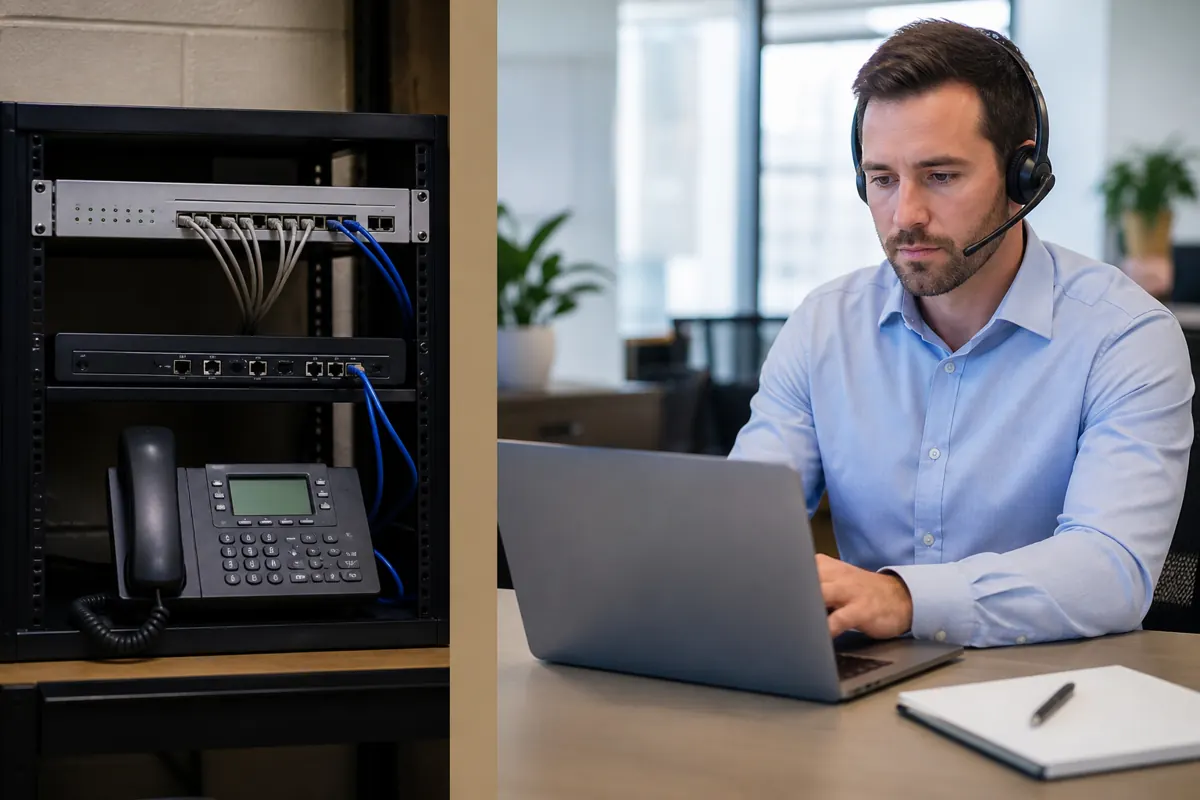
Cloud VoIP and on-premise phone systems can both deliver dependable business calling. The important difference is where the core call-control platform runs, who maintains it, and how the company adds users, locations and features.
For most small and midsize businesses, the decision is less about technical fashion and more about staffing, lifecycle cost, internet readiness and operational control.
How a cloud phone system works
With hosted VoIP, the provider operates the calling platform in its cloud environment. Office phones, mobile applications and desktop clients connect through the internet. The provider manages platform updates and core infrastructure, while the customer controls users, call flows and day-to-day settings through an administrative portal.
This model generally makes it easier to support remote employees and multiple locations. It also converts much of the phone-system cost into a recurring subscription.
How an on-premise system works
An on-premise PBX or IP-PBX places the central system at the business location or private data center. The organization owns or leases the appliance and is responsible for maintenance, software versions, capacity and recovery planning, either internally or through a service partner.
Companies with specialized integrations, existing telecom staff or strict local-control requirements may still prefer this structure. Hardware age and vendor support windows matter because a reliable system can become difficult to repair long before it stops working.
| Decision area | Cloud VoIP | On-premise |
|---|---|---|
| Upfront cost | Usually lower | Often higher for hardware and installation |
| Scaling | Add subscriptions and devices | May require licenses or capacity upgrades |
| Maintenance | Core platform handled by provider | Handled by business or maintenance partner |
| Remote work | Usually native | May require extra configuration |
| Internet dependency | Required for cloud calling | Internal calls may continue locally, depending on design |
Reliability depends on the complete design
Cloud service does not eliminate local risks. The office still needs suitable internet capacity, network configuration, power protection and a failure plan. Useful options include secondary internet, automatic forwarding, mobile applications and cellular failover. An on-premise system also needs carrier redundancy, power protection, backups and replacement parts.
Use the business phone buyer’s guide to organize requirements before comparing cloud phone system options.
Frequently asked questions
Does cloud VoIP require desk phones?
No. Users can work through desk phones, desktop applications, mobile apps or a mixture based on job role.
Can a business keep existing numbers?
Most established business numbers can be ported, subject to carrier validation and accurate account information.
Is an on-premise system always more secure?
No. Security depends on configuration, access controls, patching, network design and operating discipline in either model.